
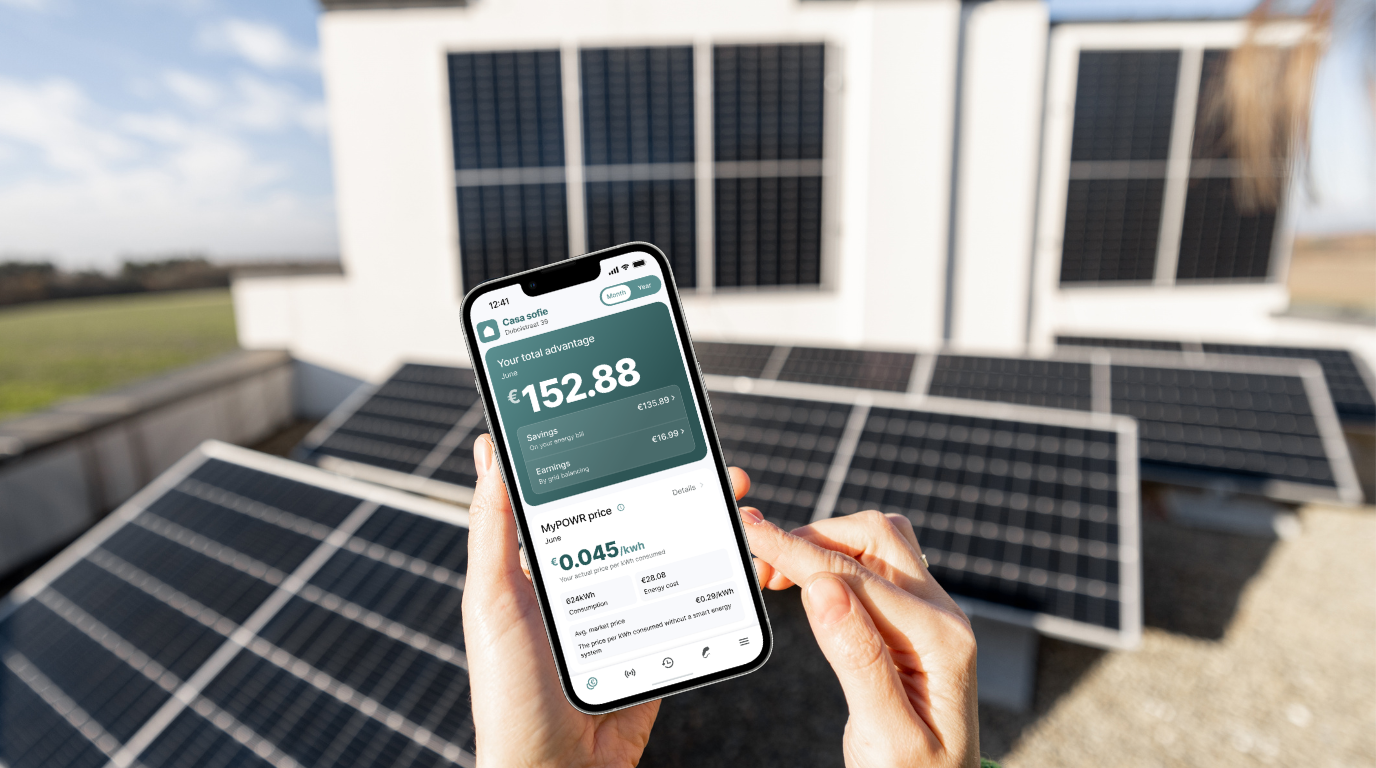
Discover how FlexiO achieved record returns on April 6, 2026, by smartly navigating the Day-Ahead, FCR, and imbalance markets. Maximise your energy!
Smart energy optimisation requires a broad view of the energy markets.
FlexiO stands out by looking beyond the Day-Ahead market alone. That is where most EMS systems stop. FlexiO optimises simultaneously on the Day-Ahead market, the FCR market (via rPOWR in collaboration with Elia) and the imbalance market (via ePOWR and supported suppliers). This combination ensures maximum returns and maximum confusion. The interaction between the various markets is sometimes less predictable, particularly if one focuses solely on a single specific price.
Moreover, every installation and user is different. Your neighbour might use their oven more than you do, or you might have a larger battery. Every installation is unique. Is your installation set up correctly and is everything working as it should? Then you will recognise one of the scenarios below.
The FlexiO principle
At FlexiO, one principle is central: creating maximum value for the user.
This maximum value is built on two pillars:
- Immediate savings: Smart local energy management ‘behind the meter’.
- Market revenues: Income from active participation in various energy markets.
It is particularly this second pillar that sometimes raises questions, as this income is often less tangible. To make this process clearer, we’ll take a closer look at a real-life example and show exactly what happened on 6 April 2026.
Market Analysis: What happened on the extraordinary energy day of 6 April?
On Easter Monday, 6 April 2026, we witnessed a unique set of circumstances in the energy markets. To understand how FlexiO responds to this, we’ll take a closer look at the three main markets:
- Day-Ahead market: The familiar dynamic prices (set at 13:00 for the following day) plummeted to zero or even negative values between 10:00 and 17:00. The logical reflex? Consume as much as possible, for example by charging your EV.
- FCR market (rPOWR): At the same time, the market for grid balancing reached record highs. Between 12 noon and 4 pm, up to €245/MW (€0.245/kW) was paid, simply to make power available. A very stable source of income on top of the dynamic prices.
- The imbalance market (ePOWR): This is where the actual real-time price is determined. Due to a massive mismatch between supply and demand, the imbalance price plummeted around 2 pm to a staggering €15,000/MWh (-€15/kWh). Every kWh purchased at that moment therefore yielded 15 euros, excluding distribution costs and taxes.
The role of FlexiO
How does an intelligent system respond to these peaks? That depends on the active markets for the installation (dynamic, rPOWR and/or ePOWR). The more markets are combined and the larger your installation, the greater the return, but also the more complex the algorithms. We demonstrate how FlexiO has managed to capitalise on these opportunities.
Case study 1: How FlexiO responds intelligently to dynamic pricing
In this example, we look at a FlexiO installation that operates exclusively on the Day-Ahead market (hourly rates). The aim? To minimise costs by using every kWh at the right time.
- Night-time: Preparing for the sun. The battery covers night-time consumption. Notably, FlexiO sometimes deliberately feeds a little extra energy into the grid to drain the battery further. Why? To create as much space as possible for tomorrow’s (free) solar power.
- The morning: Smart monetisation. The first rays of sunshine are fed directly into the grid. This is because prices are still positive at that point. FlexiO knows the battery will fill up later in the day anyway, so this early electricity is cashed in straight away.
- Afternoon: Free charging and curtailment. As soon as prices turn negative, all solar power goes into the battery. Is the battery full and the price still negative? Then FlexiO intervenes with curtailment (on supported inverter models): production is deliberately limited to prevent you from having to pay to feed power into the grid.
- Evening: Making the most of the buffer. As soon as the sun goes down and prices rise, the battery takes over again. This helps you avoid expensive grid purchases during peak hours.
Conclusion: A continuous interplay between forecasting and action ensures the highest return.
Case Study 2: Multi-market optimisation with dynamic pricing and rPOWR
In this scenario, we see how FlexiO operates in two markets simultaneously: the Day-Ahead market (dynamic hourly rates) and the FCR market (grid balancing via rPOWR). This hybrid approach ensures a more stable and higher revenue stream.
- The night: Passive earnings. Although little physical activity is visible, the battery generates revenue. This is because part of the capacity is ‘leased’ to the grid operator for balancing. The user is paid for this availability, without having to consume a single kWh.
- Afternoon: Finding the balance. FCR payments peak between 12:00 and 16:00. FlexiO deliberately maintains the battery at a strategic level (e.g. 50% SoC) to be able to both absorb and feed electricity into the grid. As part of the battery remains reserved for rPOWR, the remaining solar energy and the negative market price are utilised to charge the electric car via the smart charging point, thereby generating additional income.
- Evening: Shift to self-consumption. As soon as the balancing tariffs drop, FlexiO releases the reserved capacity. The battery is now further charged using the last rays of sunlight to bridge the expensive evening hours.
Conclusion: By combining markets, FlexiO creates a stable return that is less dependent on price fluctuations in the energy market. An additional consequence of this.
Case Study 3: How dynamic pricing combined with ePOWR generated more revenue in a single afternoon through strategic deviation
In this example, we look at a FlexiO system operating in both the dynamic hourly tariffs and the imbalance market (ePOWR). This is where the difference between a ‘smart’ battery and a ‘profitable’ battery really becomes clear.
- The forecast: One day in advance, FlexiO sends an accurate forecast to the energy supplier (here, FlexiO takes into account the household’s predicted consumption and the weather forecast). For the afternoon of 6 April, the forecast was: ‘no grid draw or injection’, as the battery would be charged using the household’s own solar power.
- The night: The role of the battery. The battery is used during the night.
- The morning: Injection and curtailment. Injection took place in the early morning. The battery was then charged by the sun. Later in the afternoon, the inverters enabling this were curtailed. The home was powered entirely by the grid because there were heavily negative tariffs.
- The real-time opportunity: Extreme prices. Around 2 pm, something extreme happened. The imbalance price plummeted to €15,000/MWh (-€15/kWh). At that moment, it was financially much more attractive to draw electricity from the grid than to use your own solar power.
- The afternoon: Unexpected behaviour. As the battery was already full, FlexiO took a bold decision: the solar panels were temporarily switched off.
Conclusion: By purchasing kWh from the grid at this negative price, a significant amount of money was made in a short space of time. This profit is directly offset against the energy bill via flex credits. FlexiO sticks to the schedule where necessary, but cleverly deviates from it as soon as the real-time market presents opportunities that no one could have predicted.
Case study 4: The ultimate synergy: How FlexiO operates across three markets simultaneously to maximise returns
In this advanced case study, we see what happens when all energy markets converge: the Day-Ahead market, rPOWR (grid balancing) and ePOWR (imbalance). This is the pinnacle of smart energy management.
- The strategy: Before 6 April, it was decided to actively participate in rPOWR, given the exceptionally high FCR remuneration, particularly between 8am and 4pm. As these revenues are fixed in advance, they represent a secure and predictable income. However, this also means that part of the battery capacity is unavailable for personal energy management.
- The night: The battery. The battery is used during the night.
- The morning: Injection. In the morning, solar power was fed into the grid, as it still had a positive value at that time.
- The real-time switch: When the imbalance prices plummeted to €15/kWh around 2 pm, the situation changed fundamentally. FlexiO intervened immediately. And the system deliberately deviated from the schedule. As the battery was reserved for rPOWR at that time, it could not be used to store extra energy. The only way to take full advantage of the market situation was therefore to draw more energy from the grid via charging points or large appliances than originally planned.
In practice, a feed-in to the grid had been planned. In reality, this was reduced to almost zero. You will be reimbursed for the difference between the predicted feed-in and the actual feed-in. This difference was settled at an imbalance price of approximately 15 euros per kilowatt-hour (excluding taxes and distribution costs), resulting in a significant gross profit in just an hour and a half.
- The profit: By cancelling the feed-in and powering the home entirely via the grid, or because the feed-in was lower than planned, a difference arose compared to the forecast. At the extreme imbalance price, this clever move generated a huge profit in just an hour and a half.
Conclusion: By simultaneously trading across three markets, FlexiO combines the security of fixed fees with the ability to capitalise on unexpected market opportunities at lightning speed.
Conclusion: The power of multi-market optimisation
The events of 6 April 2026 mark a turning point in how we view home energy. What this day teaches us is that a home battery without smart control is merely a passive storage unit, but with FlexiO, it becomes an active player in the global energy market.
The four cases discussed show a clear evolution:
- From saving to earning: Whereas traditional systems stop at avoiding grid consumption (Case 1), FlexiO goes a step further by ‘renting out’ capacity (Case 2) or actively purchasing it when the market pays for it (Case 3).
- Flexibility is worth its weight in gold: The imbalance market is volatile and unpredictable. Case 4 proves that the greatest profits do not lie in yesterday’s planning, but in today’s real-time response. By deliberately deviating from the forecast, FlexiO was able to create added value within 90 minutes that would have been impossible with a standard system.
- Synergy over specialisation: By combining the certainty of rPOWR with the opportunities of ePOWR, the business case for an energy installation becomes more robust and profitable than ever before.
What does this mean for you?
The energy market of the future is complex and full of surprises. This can be overwhelming for the user, but that is precisely where FlexiO’s strength lies: the system takes away the complexity and translates it into tangible savings on your bill.
Whether you opt for the basics of dynamic tariffs or the advanced benefits of the imbalance market, with FlexiO you are assured of a system that looks not just at the sun, but at the full economic picture. 6 April was a historic day, but in the new energy world, this is only the beginning.

